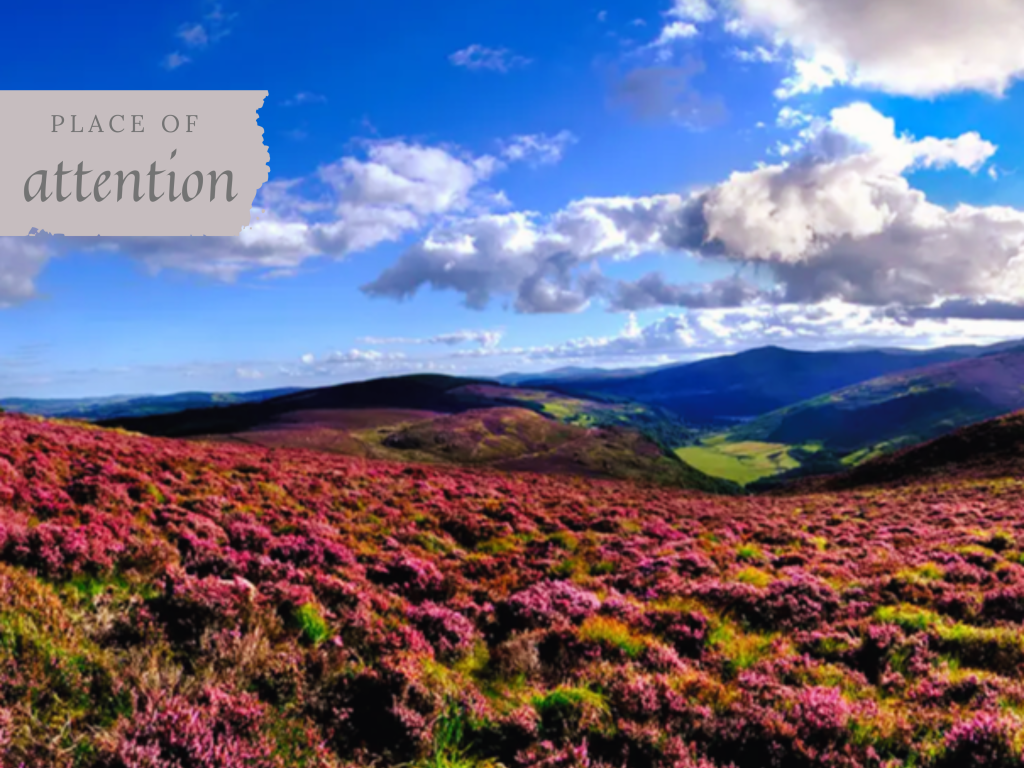
On my way to the office last Friday, I raced up Howth Hill in my Mini, taking the scenic route from the pier to the Summit. The fresh, autumnal air and the bright morning sun promised a clear view on the other side of the peninsular—a panoramic stretch across Dublin Bay to the Sugarloaf Mountain.
As I rounded the sweep and curve of the road, I surveyed the tumble of a sloping, emerald field. A nut-brown horse nodded its head at the water. The scene like a Vermeer. Not in subject, but in how the precision of detail was crisped by pristine light. Like how putting on eyeglasses pops an image to vibrancy. How the tint and tone stand up, razor the landscape into an exactness of beauty.
The song Colors came on the radio. I pumped the volume as the car gulped down the road’s ascent.
Something my friend Remy once said returned to me: “Life is the perfect lover. The more you love her, the more she loves you back.”
A few weeks ago, I wondered if I might be feeling depressed. Only a bit or it would have been more than a gentle wondering. But as I zipped through the awe of a masterpiece morning, that question vanished. The poet Maggie Smith calls such encounters with the outside world, a beauty emergency – “something you have to pay attention to right at that moment,” before it fleets.
When I mentioned to my friend and teacher Lynda Caesara the apathy that might be creeping up on me, about my work or where my life was headed, she brushed aside the things I’d been telling myself. “Oh, that’s just the nature of the conversation in that place of attention,” she said.
***
In my thirties, I thought a lot about time. Often a crazed over-worker, I routinely refused to allow Life to interrupt my concentration.
In my forties, I became more concerned with energy, whether I had the stamina demanded by task after task.
Now, past fifty, I no longer prize productivity more than aliveness.
Anyway, I have limited control over how energized I feel at any moment. This morning, for example, I rose crumpled and fogged. I might blame age for this, or the four a.m. antics of a too-youthful cat. But with little sway over how zesty I feel, I’ve become a shade wiser about where to place my attention. Where my attention hangs out affects the quality of my life more than time or energy.
Attention – from the verb attend: Latin prefix ad (to), plus the verb tendere (stretch)
Stretch toward or give heed to
To apply one’s mind or energies to.
Neuroscientists have discovered that the human mind contains a default mode network—preferred routes our consciousness travels when we let it off the leash—when we aren’t planning, plotting, or concentrating (using our executive function). The particular internal places we go may be specific to each of us, but human mind wandering, in general, tends to stray to the realm of social comparison or worry.
I wonder why So-n-So seemed less than thrilled to see me.
I wonder why my client hasn’t replied to my email.
I wonder why that person has not been in the office.
In this place of what I might label “relational puzzling”, conversations are replayed; theories invented; hypothetical dialogue imagined.
Not always. The DMN drifts off to other places too, but as tribal creatures, we have an evolutionary impulse to monitor the health of our social standing. Hence, our spare mental capacity roams to this relational place rather than considering the cosmos, contemplating the fish that swim in the sea, or whether that horse might be lonely.
***
It’s easier for the mind to follow the grooves in the landscape – paths worn by familiar revisiting, than send our attention down less trodden neural networks, which takes awareness and effort. In this recent conversation about the mind (on one of my favourite podcast series Hidden Brain), psychologist Fred Bryant explains:
We tend to spend more time counting our troubles than our blessings. It’s almost an inevitable result of evolution. The negative aspects, the threats in the environment in the world around us are dangerous and they can take our lives if we’re not cautious and don’t avoid them. Whereas the pleasures are not going to take our lives if we don’t attend to them. And the idea really is that the troubles are unavoidable and they actually kick our door in and come and find us. And we’re forced then to deal with them, to handle them.
Whereas the pleasures and the joys, they don’t hunt us down and force us to enjoy them. They wait and they sometimes hide. They require us to go hunting for them, to find them and then spend time with them.
We are wired for worry, and so when we let our attention wander, it heads for well-signposted territory: difficult family dynamics, health or money trouble, doubts about yourself or a relationship.
Then there is the external barrage, the fight for our attention from the media and marketeers. Headlines tell us: Pay attention to the climate emergency, the wars in the Middle East, and the presidential election. Or the adverts say, never mind the planet, the killings, or democracy. Book this holiday. Buy these shoes. Subscribe now if you don’t want to miss the offer of a lifetime.
Work and all forms of concentration can be a balm – rescuing us from these internal and external places of attention and into a state of flow. The same holds true for physical exertion. But we cannot (or ought not) throw ourselves into activity all of the time. We cannot learn, love or flourish when we run from the mind, the heart, and the soul.
What we can do is name the places our attention likes to go. We can ask – is this place helpful or harmful? I won’t attempt to sum up the tactics that invite us to build mindful muscles, but mental noting, labelling internal places, mapping the familiar neighborhoods paves the way to a happier mind.
We can remember that what we tell ourselves, what we believe reflects, as Lynda put it, the nature of the conversation in that place of attention. That’s all. Perhaps you can nudge your mind to come away from that place (and when your mind refuses, you can take that as a symptom of rumination and help yourself by indeed throwing yourself into mind-consuming chores or exercise.)
Finally, during those fleeting moments when you arrive in a place where everything seems wonderfully well, you can pump up the volume.
***
Recommendations – if you need a mood tonic, try Colors by the Black Pumas. Or if you’d rather wallow a while, I also love this song too from Amos Lee, same title, different tune.
I have just finished listening to Oliver Burkeman‘s new Meditations for Mortals (on audible) – “four weeks of digestible dailyish chapters” – listen or read a chapter per day for his sympathetic instruction on how to reframe your perspective and better direct your attention.
***
I’d love you to follow my blog.


8 responses to “place of attention”
A beautiful message to wake up to, Nathalie – both literately and figuratively. Thank you, Brigitta 🙏🏼💕
LikeLike
thank you so much!
LikeLike
Lovely writing Nat. Thanks.
LikeLike
Thanks Gazza!! Hope you brought your brolly today
LikeLike
Your writing cuts to the heart of things. Thanks dear Nat
LikeLiked by 1 person
thank you dear Andi! Can’t wait to see you in November
LikeLike
omg brilliant — we, your readers, are ready for your book!!!
LikeLiked by 1 person
you’ve more than anyone else has been so patient about that – ha!
LikeLike