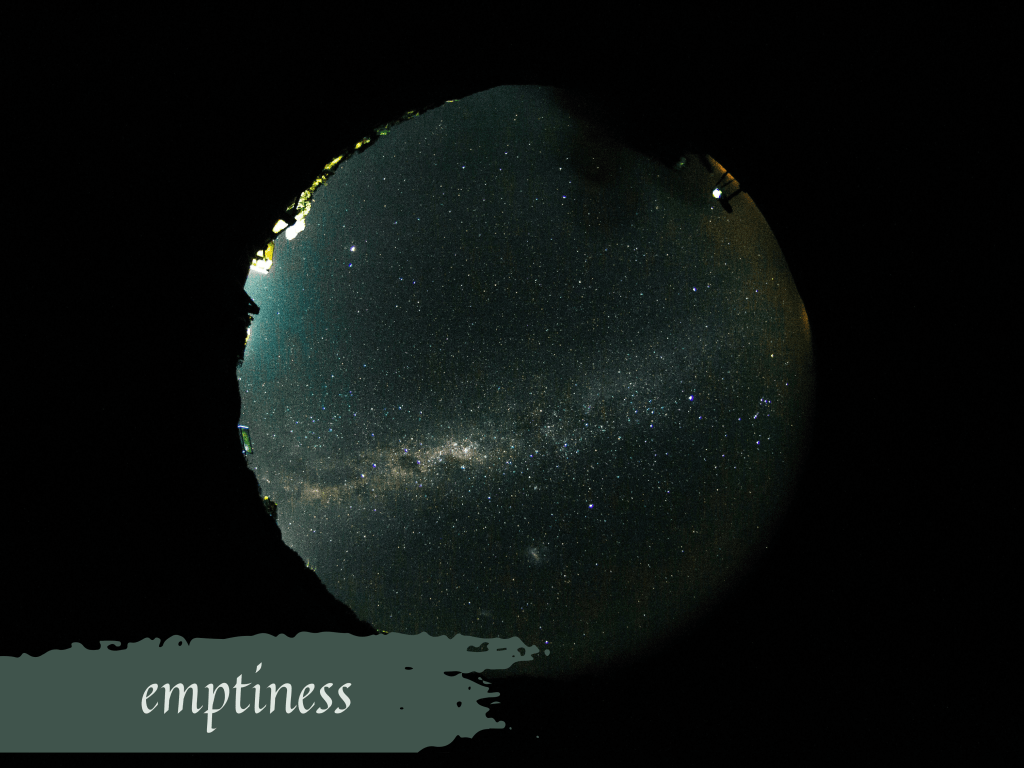
Lately, I notice an occasional emptiness. A whispering worry that something is missing. Or that I’m forgetting something, losing hold of a vague yet vital piece of life. My mind labels this “that empty feeling” – it arrives like a wind that ruffles the leaves and then slips away. It comes and it goes. I don’t welcome it. It feels a disturbance, or worse, a portent for inclement weather.
But maybe it’s only the presence of emptiness. And it’s my reaction to it that causes unease. What Buddhists refer to as the second arrow. The first is whatever has arisen or occurred. The second is how you add to your suffering by firing off a harsh judgment that does more damage than the original dent. Getting anxious about being anxious. Getting mad about feeling sad. That sort of thing.
The renowned psychologist and teacher Robert Sardello suggests that:
Mythically, we might imagine anger as Mars. Mars is not angry at anybody. Anger is just who he is. The question of anger is not what to do about it but what to do with it.
From Facing the World with Soul (1991)
I remember reading that many years ago. What to do with my sadness, my anger, my emptiness – rather than about it.
- To do something about something is to make it a puzzle for the mind
to solve. - To do something with something is to welcome it as a prompt for the heart to follow.
Newby and Watkins remind us that emotions are “the energy that moves us.” From the Latin ex or e (out) and mouvere (move). They also distinguish between emotions and moods. Emotions are event-triggered. Moods are pervasive emotional energy.
Emotions are provoked by an experience, whereas moods shape the
From The Field Guide to Emotions (2019)
experience we are having.
A sense of emptiness is more like a mood. But I believe Sardello’s advice still applies. What to do with it, rather than about it.
One of my heroes, the therapist Dr. Dick Schwartz believes that we possess many parts of ourselves. These parts don’t necessarily like one another. There may be a part of you that pushes others away, while another part criticizes you for it, accusing you all sorts of defects. There might be a part of you that boasts and another that puts you down. A part that micro-manages and a part that wishes you would just let go. Decades ago, Dr. Schwartz made the notion of an inner critic famous, a common part almost everyone knows. Unlike other approaches, the philosophy of his model asks us to appreciate the good intentions of every part, no matter how unhelpful it seems.
So if emptiness is just another part, what might it want me to know? How does it wish to serve me?
I once knew a girl who worked crazy-long hours for six months at a time and then took the rest of the year off. She was a freelance project manager. When I asked what she did with all that time, she said she did things like the cycle the long way to visit a friend who may or may not be home.
“That’s it?” I asked.
“That’s it,” she said.
She told me she lived this way to “create more open spaces.”
“Why do you want open space?”
“To make my life more complete.” she said.
“How does space make your life more complete?”
“It makes room for new things to enter it.”
Within a couple of years, she met the man she ended up marrying and had a couple of kids. The very things she had hoped for.
There is a great danger in busyness. It blocks both the pain, and all the light contained within a sense of emptiness.
Another one of my teachers talks about the void as a vast yawning chasm and the location of all possibilities. It is not empty-empty. It is empty-full. It is everything that might arrive but hasn’t yet.
Sometimes I give my emptiness a good book or a long walk. Or I call a friend or sit down to write them a letter. I’m aware that sometimes emptiness wants more. But what it wants most of all is to be accepted. Not a nuisance, not a pest, just a companion. Maybe a messenger. Maybe just a presence reminding me to take nothing for granted.
***
Resources – to learn more about Dick Schwartz’s IFS model, here’s a video introduction on how to approach the different parts of yourself.
Image credit https://unsplash.com/@yongchuan
I’d love you to follow my blog.
 antidotes
12 responses to “emptiness”
Utterly beautiful, Nathalie.
LikeLike
”Emotions are event-triggered. Moods are pervasive emotional energy. I utterly disagree.
LikeLiked by 1 person
Hi, how do you see emotions & moods differently?
LikeLike
One is fleeting, the other is not. You know this Nathalie.
LikeLike
I thought that’s what the authors meant by pervasive …. And how it shapes our experience. Maybe not.
LikeLike
Fantastic, so well written!!!!
LikeLike
‘Not a nuisance, not a pest, just a companion. Maybe a messenger. Maybe just a presence reminding me to take nothing for granted.’
yes.
so lovely to read your beautiful writing 💕 when are you in UK?
LikeLike
Would love to come visit this summer?
LikeLike
Hi Nat… I love this… I’m feeling that full-empty-full at the moment and I appreciate the welcoming of it.
With love, Sue x
LikeLike
So lovely to see your name, Sue 😍and of course makes me happy the piece names something for you
LikeLike
Am so late reading these last two posts! Love the notion of doing something with vs. about. And don’t get me started on how much empty space I require… vast unscheduled time… lovely to read your homage to it.
LikeLiked by 1 person
one of the major gifts of no longer being full time employee — arranging one’s days …
LikeLike